
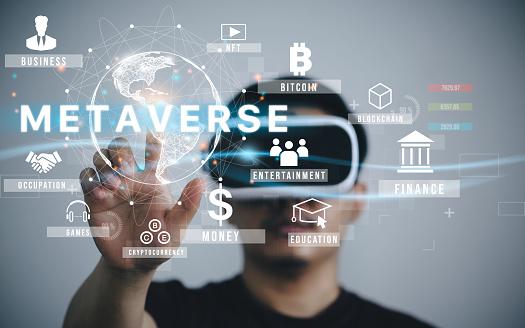
Greetings from the metaverse. Where exactly are we right now? Imagine for a moment the next edition of the internet fusing our real-world and virtual existences flawlessly. It serves as a gaming platform, a virtual storefront, a tool for training, a platform for advertising, a digital school, and a portal to brand-new virtual experiences, among other things. The metaverse is still being defined, but it already has the ability to spark the next round of digital disruption. More than $120 billion has been spent on developing the metaverse's technology and infrastructure in the first five months of 2022. That is more than twice the $57 billion that was invested in 2021 as a whole.
Are you curious to know more about Metaverse as a Service? So we created a blog specifically for you!
Don't believe us; check it out for yourself. Continue reading to discover some fascinating statistics, as well as the advantages of MaaS and a few cases.
An Overview of the Metaverse
Users can take part in a social economy based on real-world circumstances in the network of connected 3D virtual worlds known as the Metaverse. On the spatial communications platform, you may collaborate with your coworkers, buy and sell goods, make money, make friends, and establish brands.
Blockchain technology is used to power the metaverse, which is intended to be a decentralized environment run by multiple parties. Or to put it another way, it makes an effort to imitate democracy in a digital environment.
The word "Metaverse" was created by author Neal Stephenson in his 1992 book Snow Crash. With the introduction of multiplayer world-building games like Second Life, Minecraft, and Roblox, it became well-known in the technology sector.
How Will The Future Of The Metaverse Be? - A Few Vital Statistics And Facts
The prefix "meta" (beyond) with the stem "verse" make up the phrase "metaverse" (universe). Thus, "Metaverse" literally means "beyond the Universe."
The Metaverse market is expected to increase from $47.69 billion in 2020 to $800 billion by 2024. This is more than the $47 billion projections for 2020.
In 1992's "Snow Crash," a science fiction book, the phrase "metaverse" was first used.
Recently, Meta pledged $50 million to non-profit groups to support the responsible expansion of the metaverse.
JP Morgan predicts that the Metaverse's market cap will reach $1 trillion in the future.
A number of significant tech companies see the metaverse as a once-in-a-lifetime chance to expand their reach.
Describe MaaS.
Metaverse as a Service is referred to as MaaS. A business solution called MaaS enables organizations to create and enhance their presence in a 3D virtual world for collaboration, commercial activities, investments, cryptocurrency, and other relevant use cases.
Importantly, MaaS will let businesses to take advantage of the existing Metaverse infrastructure, just like SaaS does, rather than helping them develop their own Metaverse clones to compete with Decentraland or Roblox.
Benefits of "Metaverse as a Service"
Solutions for the metaverse can be created by businesses with little to no digital experience. Small and medium-sized businesses can participate in the Metaverse as a service economy without having to shell out a lot of money for capital. Let me list a few advantages of Metaverse as a service.
Immersive encounter
The benefit of the metaverse is that it makes whatever you're doing more immersive. Everything is encountered in the most captivating way possible, enabling more personal and professional possibilities. You can work out, interact with others, have fun, play games, and conduct business in a virtual setting.
In a technology that is still in its infancy, it encourages investment. Alternatives like Meta's Horizons suite of apps or Microsoft Mesh haven't yet gained traction because the majority of platforms are currently restricted to specific user scenarios. In this situation, MaaS enables companies to invest in technology with little risk and profit from it.