
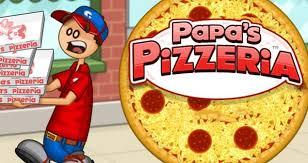
There’s something oddly specific about the kind of stress that comes from a pizza order going wrong in Papa’s Pizzeria. Not real stress—the kind that ruins your day—but the tight, focused pressure of knowing a virtual customer is about to judge you for uneven pepperoni placement.
It sounds trivial. It is trivial. And yet, it sticks.
I didn’t think much of it the first time I played. A simple browser game, a few mechanics, nothing groundbreaking. Take orders, add toppings, bake, slice, serve. Repeat. But somewhere between the third and tenth in-game day, something shifted. I stopped playing casually and started playing carefully.
That’s where these games get you.
The Illusion of Simplicity
On the surface, Papa’s Pizzeria is as straightforward as it gets. A customer walks in, you take their order, and you try to replicate it as accurately as possible. The game gives you just enough structure: a ticket system, topping guides, baking timers, and a slicing interface.
But the simplicity is deceptive.
Each step introduces just enough room for error. You can place toppings slightly off. You can leave the pizza in the oven a few seconds too long. You can cut uneven slices that don’t match the requested portions. None of these mistakes feel catastrophic, but they all add up in the final score.
And that score matters more than it should.
What’s interesting is how the game doesn’t overwhelm you immediately. It ramps up slowly. A few customers per day turn into a steady stream. Orders become more complex. You start juggling multiple pizzas at once, mentally tracking baking times while trying to remember who ordered what.
At some point, you stop reacting and start planning.
The Quiet Stress of Multitasking
There’s a specific moment I remember: three orders lined up, one pizza halfway baked, another still being topped, and a third customer waiting at the counter. I hesitated for a second too long, and everything slipped slightly out of sync.
That’s the core tension.
The game doesn’t punish you harshly, but it constantly nudges you toward optimization. You begin to think in sequences: start this pizza, move to toppings for the next, check the oven, return to slicing. It becomes a loop of micro-decisions.
And when you get it right, it feels surprisingly good.
Not in a dramatic, high-stakes way—more like a quiet satisfaction. A smooth run. No burnt edges, no misplaced toppings, no angry customers. Just a clean execution of a system you’ve internalized.
It’s the same kind of satisfaction you get from organizing a messy spreadsheet or finally fixing a stubborn formula. Small, contained, but deeply rewarding.
Why It Becomes Addictive
I don’t think the game is addictive because it’s exciting. It’s addictive because it’s consistent.
You always know what’s expected of you. The rules don’t change. The mechanics stay stable. What changes is your ability to handle them more efficiently.
That creates a loop that’s hard to break:
- You make small mistakes
- You notice them
- You adjust your approach
- You perform slightly better next time
It’s incremental improvement, packaged in a low-risk environment.
There’s also the scoring system. Customer satisfaction isn’t just a number—it’s feedback. A slightly lower score on toppings tells you exactly where you went wrong. A poor baking score means you mistimed the oven. The game is constantly teaching you, but it doesn’t feel like teaching.
It feels like you just need one more day to get it right.
That “one more try” mindset is something I’ve seen in other games too, especially in time-management titles. If you’ve ever played something like Diner Dash or even newer mobile cooking games, the pattern is familiar. But Papa’s Pizzeria does it with almost no extra layers. No flashy graphics, no complex progression systems.
Just repetition and refinement.
The Nostalgia Factor
Part of the appeal now is definitely nostalgia.
Browser games had a different kind of presence. You didn’t install them. You didn’t commit to them. You just opened a tab and played. Maybe during a break, maybe while procrastinating something else.
Papa’s Pizzeria fits perfectly into that era.
It reminds me of a time when games didn’t demand attention—they quietly occupied it. There was no pressure to keep up, no daily rewards to claim, no notifications pulling you back in. You played because you wanted to, and you stopped when you were done.
And yet, somehow, it stayed with you.
Even now, years later, I can still picture the order tickets, the topping layout, the way the oven meter slowly fills. That kind of memory doesn’t come from complexity. It comes from repetition and clarity.
Small Systems, Strong Habits
What fascinates me most is how such a simple game builds habits.
You start by following instructions. Then you start anticipating them. Eventually, you develop your own internal system—your way of handling orders, your preferred sequence of actions.
It’s not unlike learning a workflow in real life.
In fact, it reminds me a bit of how people approach tools like Excel or SQL. At first, everything is manual and slow. Then patterns emerge. Shortcuts develop. You stop thinking about each step and start thinking about the outcome.
That shift—from conscious effort to automatic behavior—is where the game quietly succeeds.
If you’re interested in how small systems shape learning, it’s something I’ve touched on in [another post about building habits through simple tools]. The principle is the same: keep the system clear, and let repetition do the rest.
The Subtle Satisfaction of Getting It Right
There’s no dramatic win condition in Papa’s Pizzeria. No final boss, no big ending. Just days that get progressively busier and scores that (hopefully) get progressively higher.
But that’s enough.
Because the real reward isn’t progression—it’s execution.
A perfectly made pizza, delivered on time, with high scores across the board, feels like a small personal win. Not because it matters, but because you know exactly what it took to get there.
And when something goes wrong, it’s rarely random. You can trace it back. A missed timer. A rushed topping placement. A moment of inattention.
That clarity makes improvement feel achievable.
It’s also why the game pairs so well with the idea of practice. Not intense, focused practice—just casual, repeated attempts. The kind where you don’t even realize you’re getting better until you look back.
If you’ve ever struggled with applying what you learn—whether in games or in something like data analysis—you might recognize this pattern. I’ve written a bit about that gap between learning and doing in [this reflection on practice vs. application], and it shows up here in a surprisingly similar way.
Why It Still Matters
It’s easy to dismiss games like Papa’s Pizzeria as simple distractions. And in a way, they are.
But they also highlight something important: you don’t need complexity to create engagement. You need clarity, feedback, and a system that rewards small improvements.